What documentation should I maintain when attempting to locate the owner of unclaimed trust account funds?
Attorneys should maintain records demonstrating their reasonable efforts to locate and contact the owner of the funds. Such documentation may include:
Letters sent to the owner’s last known address.
Email correspondence.
Telephone call logs and notes.
Returned mail.
Internet or public-record searches.
Communications with former counsel or known representatives.
Maintaining evidence of these efforts helps demonstrate compliance with trust accounting requirements and California’s unclaimed property laws. These records should be retained with the client file and be available to support decisions regarding the reissuance, distribution, or escheatment of funds.
How long can client or third-party funds remain in my trust account before they must be remitted to the State Controller’s Office?
California’s Unclaimed Property Law generally requires funds held in a fiduciary capacity that remain unclaimed after the applicable holding period to be reported and remitted to the California State Controller’s Office. For many trust account funds, this period is three years, provided reasonable efforts have been made to locate the owner.
Attorneys should not allow funds to remain indefinitely in a trust account. Outstanding balances should be reviewed regularly, and firms should maintain documentation of their efforts to identify, contact, and distribute funds to the rightful owner before considering escheatment.
Should I send unclaimed client trust funds to the State Bar of California?
No. The State Bar of California is not the repository for unclaimed client trust funds.
When entrusted funds cannot be distributed because the client or third-party owner cannot be located despite reasonable efforts, the funds may become subject to California’s Unclaimed Property Law. In those circumstances, the funds may need to be reported and remitted to the California State Controller’s Office, which is responsible for receiving and safeguarding unclaimed property.
What should I do if I have a trust account check that has not been cashed?
If a trust account check remains outstanding, the firm should promptly investigate the reason it has not been negotiated. Reasonable efforts should be made to contact the payee and determine whether the funds should be reissued, redistributed, or otherwise disbursed.
The firm’s efforts should be documented and reviewed as part of the monthly trust account reconciliation process. If the payee cannot be located and the funds remain unclaimed for the applicable dormancy period, the funds may be subject to California’s unclaimed property laws and may need to be reported and remitted to the California State Controller’s Office.
What is the difference between arbitration and mediation?
Both arbitration and mediation involve a neutral third party. In arbitration, the arbitrator hears evidence and arguments, and then issues a decision that may be binding or nonbinding. In mediation, the mediator helps the parties reach their own voluntary agreement.
Can my attorney require me to participate in fee mediation?
No. Both sides must agree to mediation. The State Bar will notify the opposing party if mediation is requested.
What is the deadline for requesting fee arbitration and mediation?
If you received a Notice of Client’s Right to Fee Arbitration form from the attorney, you have 30 days from the date you received it to submit your arbitration request form to the program. You must also submit your arbitration request if you first wish to mediate the fee dispute.
If you do not file the request form within 30 days of receiving the notice, you will lose your right to arbitrate your fee dispute. A telephone call or letter to the program requesting arbitration will not protect that right. You must be sure that the request form is complete and submitted with any required filing fee.
If the attorney has already filed a lawsuit against you for unpaid fees, you may elect either to respond to the lawsuit or request fee arbitration. If you file a response to the lawsuit, you will lose your right to arbitrate the fee dispute. If you request arbitration, the lawsuit will be stayed, but you should file the appropriate notice of automatic stay with the court. To preserve your right to arbitrate, you should file a request for arbitration promptly.
Your request for mediation is part of the State Bar request for arbitration, so it will follow the same timelines listed above.
If I think an attorney has engaged in misconduct or malpractice, will fee mediation help me?
No. The mediator will not decide any issues related to attorney misconduct and/or malpractice and has no authority to make any determinations regarding the attorney’s conduct or to discipline attorneys for professional misconduct.
If you wish to file a disciplinary complaint with the State Bar of California about your attorney’s conduct, you may do so online. Please keep in mind that a discipline complaint and a request to arbitrate and mediate a fee dispute are separate matters. Filing a complaint may result in disciplinary action against the attorney; however, the result may or may not require the attorney to refund fees.
If you think you have a separate claim for legal malpractice, you should seek legal counsel.
May I ask for fee mediation if I want a refund of fees I have already paid to an attorney?
If you are seeking a refund of attorney’s fees that you have already paid, you may request fee mediation as a preliminary option along with arbitration as long as you are still within the legal time limit for filing a lawsuit about the fee dispute. To preserve your right to arbitrate, and to potentially mediate a fee dispute, you should file a request for arbitration promptly.
How do I request fee mediation?
For disputes filed with the State Bar, simply check the box agreeing to mediate on the request for fee arbitration form. Some local bar associations offer fee mediation in addition to fee arbitration. Find local fee arbitration programs.
How do I file a complaint against my lawyer or a lawyer referral service?
If you believe your lawyer has done something wrong, you can file a complaint with the State Bar. Complaints may be submitted online or by mail. If you have questions or need assistance in completing the form, call the State Bar’s Attorney Complaint Hotline at 800-843-9053. For more information on reporting a lawyer to the State Bar and handling other problems, read the legal guide If You Have a Problem with an Attorney.
If you have a complaint about a certified or uncertified LRS, you can file a complaint against the service with the State Bar. In order to promote public protection, the State Bar will review your complaint to determine if the LRS has violated Business and Professions Code Section 6155 and State Bar Rules.
For more information on certified lawyer referral services, contact LRS@calbar.ca.gov.
When are the annual fees due?
The due date is by March 30, or the next business day if that date falls on a weekend or holiday, each year during the annual license renewal process. The 2025 annual deadline is April 1, 2025. If you miss the deadline, you will be charged a penalty ($103 for active attorneys, $31 for inactive attorneys).
What activities qualify for general MCLE credit?
Activities that qualify for general MCLE credit must: (1) relate to legal subjects that are directly relevant to California attorneys, and (2) offer current, significant educational, professional, or practical content with the specific objective of increasing each participant’s professional competency as an attorney. Programs created primarily for nonattorney audiences (for example, general public, clients, or business staff) do not qualify and will not be approved for general MCLE credit. More on Standards for MCLE activity Approval.
What is IOLTA?
IOLTA stands for Interest on Lawyers’ Trust Accounts. Attorneys deposit client funds that they plan to hold briefly, or that are too small to earn interest for the client, into larger shared accounts. Over 73,000 attorneys make deposits in approximately 49,000 IOLTA accounts in California. As of September 2019, IOLTA accounts hold nearly $5 billion. Any interest earned on these accounts is paid by financial institutions to the State Bar, which in turn distributes those funds as grants to qualified nonprofit civil legal organizations throughout the state.
Refer to the State Bar’s IOLTA FAQ page for more information.
May I provide personal or individual representation to anyone other than through my employer?
No. You may provide legal services only to your employer. You are not permitted to provide personal or individual representation to any customers, shareholders, owners, partners, officers, employees, servants, or agents of your employer.
What kinds of activities count only for self-study credit?
The following activities count only for self-study credit:
Self-assessment tests
Writing a legal article accepted for publication
What is a Special Master?
Special Masters are volunteer attorneys who accompany peace officers in searches for documentary evidence in the possession of or under the control of attorneys, physicians, psychotherapists and clergy.
Are attorneys allowed to accept an advance fee if they place the fee in a Client Trust Account or escrow account until they complete all contracted services?
No. The language of Civil Code section 2944.7(a)(1) is sufficiently broad and prohibits the collection or receipt of any fee for loan modification services prior to the completion of all contracted services.
What evidence does the arbitrator use to make a decision?
One of the first things the arbitrator will look at is whether there is a written fee agreement. If there is, the parties should submit a copy of the agreement to the arbitrator. In most instances, lawyers are required to use written fee agreements. If they do not, however, they are still entitled to a reasonable fee. The arbitrator will also consider the testimony of the parties, the billing statements, and other relevant evidence presented.
What documents should I submit and how should I organize them?
You may want to consider submitting any letter or documents that may support your claim. These include but are not limited to the lawyer’s billing statement, evidence of payments to the lawyer (e.g., copies of void checks), and any written fee agreements. Any other letters or documents that support your claim. You should have your documents organized in the order in which you plan to present them. Putting them in order by date is one common way to do this. You should also plan to have additional copies of the documents you intend to present so that you can give the copies to the arbitrator and the attorney whose fees you are disputing.
What is the award?
The award is the decision of the arbitrator and specifies whether you owe money to the lawyer, whether the lawyer owes money to you or whether neither of you owes any money.
Do I need to complete a course in one sitting?
No. E-learning courses can be completed on your schedule, at your own pace. Leave the course at any time and your progress will be saved until you return. Depending on the type of screen you are on when you exit, the course will resume at that point or at the beginning of the same section. Once you complete the course, you will be given access to a certificate that can be saved or printed to document course completion.
IMPORTANT: Upon returning to the course, you must answer “Yes” to the introductory question “Would you like to resume where you left off?” If you answer “No” to the introductory question, the course will be reset to the beginning and any record of your prior progress will be lost.
Can I use these courses to satisfy a portion of my full MCLE requirement?
Yes. The State Bar New Attorney Training is not MCLE, however, new licensees can apply State Bar New Attorney Training hours to their MCLE requirement, provided that the hours are completed within the licensee’s MCLE compliance period. (Rule 2.142 of Title 2, Division 6, Chapter 1 of the Rules of the State Bar.)
By completing the entire New Attorney Training Program, you will complete 10 hours of MCLE credit, including 5.25 hours of legal ethics, 1.75 hours of general, 1 hours on competency, 1 hour on civility, and 1 hours on recognition and elimination of bias.
The title and the amount of credit offered by each course will depend on when the course was complete. See the table below.
Image
Can I call myself a “California Attorney” or a licensed attorney of the State Bar of California once I am approved through the MJP Program?
No. You may not claim in any way to be a licensed attorney of the State Bar of California. You must use the applicable title in connection with your activities performed under the MJP Program:
• Registered In-House Counsel
• Registered Legal Aid Attorney
• Specially Registered Attorney (in lieu of Registered Military Spouse Attorney)
How long will it take to process my Testing Accommodations Application? Will I have time to appeal the decision, if needed?
Processing may take up to 60 days from the date your Testing Accommodations Application is deemed complete by the State Bar. If you submit an application on or close to the final filing deadline, there may not be enough time after receiving a decision to submit a request for review. However, you can submit a request for review for a subsequent administration of the exam, if needed. Early filing is strongly encouraged.
I’ve been granted extra time. Where can I find the schedule?
Sample schedules for extended time are posted online. Detailed testing schedules for each administration of the CBX will be sent to applicants via a Testing Accommodations Notice once logistics are finalized. Please note that schedules for subsequent exam administrations are subject to change.
When will the PLP sunset for first-time takers of the February 2025 CBX?
The PLP will sunset for first-time takers of the February 2025 CBX on December 31, 2027.
I understand that I must immediately report the termination of supervision by my Supervising Lawyer to the State Bar. How do I report this?
Once you are no longer supervised by your Supervising Lawyer, you must immediately:
• Log in to the Applicant Portal.
• Click on your most recent PLP case number.
• Report the termination by posting the information, including the date and reason for termination, to your most recent PLP case.
• Alternatively, you can also submit a general request through the Applicant Portal by clicking on the Help Center.
Can I omit my residential address from the PHV application?
No. Pursuant to rule 9.40 of the California Rules of Court, the application must include the out-of-state attorney's residence and office address.
What are the key requirements I need to satisfy by May 31, 2023, to continue in the program?
The program will terminate on May 31, 2023, for any participant who:
Has not completed the State Bar’s 10-hour New Attorney Training; or
Has not received an 86 or higher on the MPRE; or
Does not have an active positive moral character determination*; or
Does not submit all documentation required by the State Bar; or
Does not have an eligible supervisor committed to supervise the participant through the end of 2023.
*If you have received a negative determination, you will be immediately suspended from the PLP and cannot practice as a PLL. However, you will not be terminated from the program until time has passed to request a review or final appeal, or the review or appeal has concluded. If following the review or appeal you are issued a positive moral character determination, you can continue in the program through December 31, 2025, while you seek to pass the bar exam. If you had other outstanding requirements as of May 31, 2023 (for example, you hadn’t yet received an 86 or higher on the MPRE), you will be terminated from the program as of May 31, 2023, regardless of the status of your moral character determination.
My positive moral character determination expires in four months. Will the pending expiration stand in the way of me getting admitted into the PLP?
No, but once your positive moral character determination expires, if you don’t have a completed application for extension on file, you will be suspended from the program. Applications for Extension of Moral Character Determination are simpler and can be filed up to six months before the expiration of your positive determination.
How do participants in the Pathway PLP report their hours to the State Bar? And how frequently?
Hours must be tracked and submitted to the Office of Admissions on a weekly basis. Specifically, PLLs will be required to note the total number of hours worked, the total number of hours spent performing legal services (whether paid or unpaid), and a description of the supervised legal practice duties assigned that specific week. When the hours are submitted, the State Bar will contact the supervising lawyer to sign that week’s completed log. To access the time-tracking log:
Once that timesheet record has been saved, the applicant will receive an email with a link to capture their electronic signature. After receipt of that electronic signature, an email will be sent to the supervising attorney to confirm the hours reported.
Once a PLL has logged a total of 300 hours of supervised legal practice, an email will be sent to the supervising lawyer requesting an evaluation of the PLL’s overall work performance. Once that evaluation has been completed, it will be reviewed by the eligibility team to determine whether the PLL has satisfactorily met the requirements of California Rule of Court 9.49.1 (i).
May a provisionally licensed lawyer have multiple supervising lawyers to get a broader range of experience?
Yes, the rules allow for multiple supervisors. The supervisors may work within the same law firm or at a different law firm if you will be employed or volunteer at more than one organization. You must submit a declaration from each supervising lawyer with your application in the Applicant Portal. You may not work at any organization unless you have submitted a declaration from a supervising lawyer with that organization, and the State Bar has approved the supervisor as eligible.
The instructions state that applicants for admission to practice law in California have a continuing duty to update their responses. What is the best way to update my application?
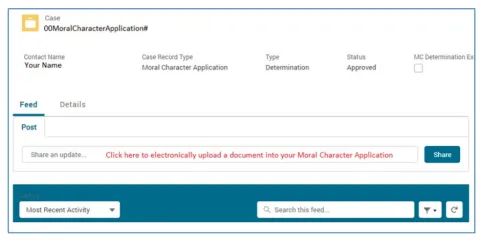
You are required under rule 4.42 of the Rules of the State Bar of California to update your responses within 30 days, whenever information provided in the application has changed or there is new information relevant to the application, until you have taken the attorney’s oath. To update your application, please log in to the Applicant Portal and access your moral character case. Use the feed on your moral character case to post an update or upload a document.
Figure 1: Posting an update or document to a Moral Character Case
Image
Contact us
Need additional help? Visit our Contact Us page for additional resources.