Can I have an extension to submit a request for administrative review?
No. The State Bar is unable to extend the period to request administrative review. The CBE will decide whether to accept an untimely request for administrative review.
What are the possible outcomes once I submit a request for administrative review?
The CBE will review your request and your application. The CBE may take any action it deems appropriate, including but not limited to granting you a positive determination, requesting more information, extending an offer of abeyance, or rendering an adverse determination.
If the CBE declines to grant you a positive determination, it will decide how long you must wait before you may submit a new Application for Determination of Moral Character, which could be the same or different from the time that was set by State Bar staff when it made the initial determination.
What happens if I am given an adverse moral character determination?
The notice of the adverse determination will provide you with the date on which you may submit a new Application for Determination of Moral Character. You are encouraged to engage in affirmative rehabilitative activities during the period you must wait to reapply.
Alternatively, you may choose to request administrative review by the Committee of Bar Examiners (CBE). If you request review by the CBE, the date on which you will be eligible to reapply may change, as it will be determined by the CBE in the event it issues an adverse determination.
My application is in drafted status, and I am experiencing technical issues. What is the best way to resolve the issue?
Please call 415-538-2450 and ask to speak with the Moral Character Person of the Day. Please be prepared to email a screenshot if the issue cannot be resolved over the phone. Some issues may take more time to resolve if technical assistance is necessary.
I travel a lot, including overseas, and I cannot recall every address where I lived. How do I appropriately respond to the “Residence” section of the moral character application?
Some applicants have traveled extensively in the past three years and have numerous addresses to report on the moral character application. You are encouraged to provide as much information pertaining to each residence as can be reasonably recalled. You are responsible for the complete and accurate reporting of information on the application to the best of your ability, and the failure to provide complete responses could result in a delay in the processing of the application.
How long must I have resided at a particular location for the residence to be reportable on the moral character application?
You must disclose all residences for the past three years, regardless of how long you resided at the location.
Do I have to disclose all past residences, no matter how long ago I resided at a location?
No. You are only required to disclose the addresses of the places you have lived within the past three years, including college and law school residences.
Some of my references told me they did not receive a questionnaire after I submitted my application; should I be worried?
No. Some references may not be contacted. You may wish to remind your references to check their email spam folders periodically and to use the Google Chrome internet browser, if possible, when submitting the questionnaires to avoid potential technical issues.
How do I properly report my enlistment and job in the military?
Report military enlistment in the “Current/Previous Employment section” and the “Military Services” section of the moral character application. List your last duty station, supervisor, date of enlistment, and date of discharge (or the date you left active duty if you are currently on inactive status). An applicant who is discharged from active duty must also provide a DD-214 military discharge document that clearly indicates the type of discharge.
What do I do if I do not know the supervisor’s email address?
Contact the employer and attempt to obtain the information. If you do not remember your supervisor’s name or your supervisor is no longer with the business, please enter "Human Resources" into the Full Name of Supervisor field and enter the appropriate information into the Email Address of Supervisor and Phone Number of Supervisor fields.
If the company is no longer in business (defunct), contact information will not be required once you indicate that the company is no longer in business.
Do NOT use your own email address or phone number.
What is the criteria for financial assistance and how much does it cover?
Contact the LAP office for details about the income eligibility requirements and the application process. Financial assistance can cover up to one year of LAP group fees and one year of lab testing fees.
There is no set time for Support LAP. It is completely voluntary. Participants can enroll, withdraw, and re-enroll whenever they want to.
What happens if I don’t I get a bar number immediately?
After submitting your completed membership enrollment card, allow one to two weeks for delivery, then check Attorney Search to confirm your enrollment and find your bar number. If you do not see your name on the State Bar website after two weeks from the date you submitted the card, call 888-800-3400 or email AttorneyRegulation@calbar.ca.gov.
I work for a California company. However, I work remotely and live out of state. Can I participate in the MJP Program as Registered In-house Counsel?
No. Pursuant to rule 9.46 of the California Rules of Court and Title 3 Division 3 Chapter 1 Article 3 of the Rules of the State Bar, you must reside in California. As defined in rule 3.370(D), this means that you must live or be located in California on more than a temporary or transient basis.
I’ve been granted extra time. Where can I find the schedule?
Sample schedules for extended time are posted online. Detailed testing schedules for each administration of the CBX will be sent to applicants via a Testing Accommodations Notice once logistics are finalized. Please note that schedules for subsequent exam administrations are subject to change.
How are the exam questions delivered?
For the FYLSX, applicants receive the multiple-choice questions electronically and must select their answers using a computer.
How do I know if I will be working for an IOLTA-funded organization?
“IOLTA” stands for Interest on Lawyers’ Trust Accounts. IOLTA is a method of raising money, primarily for providing legal services to those unable to afford them.
The State Bar’s Legal Services Trust Fund Program collects the interest generated by IOLTA accounts and distributes the funds to more than 100 nonprofit legal aid organizations that provide civil legal aid to indigent Californians.
You can look up the IOLTA-funded organizations, and you can learn more about IOLTA accounts on the State Bar’s website.
What are the requirements for a Supervising Lawyer?
To qualify to supervise a PLL, the supervisor must have practiced law for at least four years and have actively practiced law in California or taught law at a California Law School for at least two years immediately preceding the period of supervision.
Supervising lawyers may also be judges of a court of record in the California judicial branch.
Registered In-House Counsel and Registered Military Spouse Attorneys and others “specially admitted” are not California licensed attorneys and cannot act as supervisors for a PLL.
Supervising lawyers must be active licensees in good standing, and must not be ineligible to practice, suspended, under a stayed suspension order, or have resigned or been disbarred in any jurisdiction.
• Supervising lawyers must agree to assume professional responsibility for any work of the PLL and must be prepared to assume personal representation of the PLL’s clients.
What are the key requirements I need to satisfy by May 31, 2023, to continue in the program?
The program will terminate on May 31, 2023, for any participant who:
Has not completed the State Bar’s 10-hour New Attorney Training; or
Has not received an 86 or higher on the MPRE; or
Does not have an active positive moral character determination*; or
Does not submit all documentation required by the State Bar; or
Does not have an eligible supervisor committed to supervise the participant through the end of 2023.
*If you have received a negative determination, you will be immediately suspended from the PLP and cannot practice as a PLL. However, you will not be terminated from the program until time has passed to request a review or final appeal, or the review or appeal has concluded. If following the review or appeal you are issued a positive moral character determination, you can continue in the program through December 31, 2025, while you seek to pass the bar exam. If you had other outstanding requirements as of May 31, 2023 (for example, you hadn’t yet received an 86 or higher on the MPRE), you will be terminated from the program as of May 31, 2023, regardless of the status of your moral character determination.
My positive moral character determination expires in four months. Will the pending expiration stand in the way of me getting admitted into the PLP?
No, but once your positive moral character determination expires, if you don’t have a completed application for extension on file, you will be suspended from the program. Applications for Extension of Moral Character Determination are simpler and can be filed up to six months before the expiration of your positive determination.
How do participants in the Pathway PLP report their hours to the State Bar? And how frequently?
Hours must be tracked and submitted to the Office of Admissions on a weekly basis. Specifically, PLLs will be required to note the total number of hours worked, the total number of hours spent performing legal services (whether paid or unpaid), and a description of the supervised legal practice duties assigned that specific week. When the hours are submitted, the State Bar will contact the supervising lawyer to sign that week’s completed log. To access the time-tracking log:
Once that timesheet record has been saved, the applicant will receive an email with a link to capture their electronic signature. After receipt of that electronic signature, an email will be sent to the supervising attorney to confirm the hours reported.
Once a PLL has logged a total of 300 hours of supervised legal practice, an email will be sent to the supervising lawyer requesting an evaluation of the PLL’s overall work performance. Once that evaluation has been completed, it will be reviewed by the eligibility team to determine whether the PLL has satisfactorily met the requirements of California Rule of Court 9.49.1 (i).
May a provisionally licensed lawyer have multiple supervising lawyers to get a broader range of experience?
Yes, the rules allow for multiple supervisors. The supervisors may work within the same law firm or at a different law firm if you will be employed or volunteer at more than one organization. You must submit a declaration from each supervising lawyer with your application in the Applicant Portal. You may not work at any organization unless you have submitted a declaration from a supervising lawyer with that organization, and the State Bar has approved the supervisor as eligible.
The instructions state that applicants for admission to practice law in California have a continuing duty to update their responses. What is the best way to update my application?
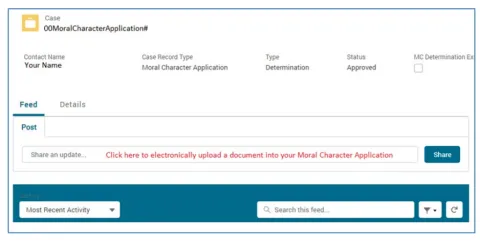
You are required under rule 4.42 of the Rules of the State Bar of California to update your responses within 30 days, whenever information provided in the application has changed or there is new information relevant to the application, until you have taken the attorney’s oath. To update your application, please log in to the Applicant Portal and access your moral character case. Use the feed on your moral character case to post an update or upload a document.
Figure 1: Posting an update or document to a Moral Character Case
Image
Do I have to disclose my criminal history on my law school application? Should I update my law school application if I am arrested or convicted during law school?
Criminal history questions on law school applications vary widely. The State Bar is unable to provide advice concerning any particular application, including whether the application requires disclosure of arrests, convictions, or other criminal history information. An applicant should contact their law school for information about its application disclosure requirements, and under what circumstances updates to the law school application are required.
Contact us
Need additional help? Visit our Contact Us page for additional resources.