
Frequently Asked Questions: Moral Character Determinations
General Information
What do I need to know before beginning the online Application for Determination of Moral Character or Application for Extension of Determination of Moral Character?
Please review the information regarding the Moral Character requirement, including the instructions for the Application for Determination of Moral Character and Application for Extension of Determination of Moral Character.
Where can I find general information about the standards for making moral character determinations?
Please review the Moral Character Statement and the Moral Character Determination Guidelines.
Am I required to disclose a situation or issue that does not appear in the Moral Character Determination Guidelines?
Maybe. Please carefully review the instructions and questions to determine the disclosure requirements.
The guidelines contain examples of issues that may be relevant to a moral character determination and do not provide an exhaustive list of all potentially relevant issues. Applications are considered individually. Accordingly, the guidelines neither bind nor limit the discretion of the decision-makers, but rather provide a framework to assist the decision-makers and provide applicants with information about the process. The severity of an act of misconduct, length of time since the act, and the frequency with which the act occurred are among the factors that will be taken into consideration in making a moral character determination.
What if I don’t know all the answers to complete a form for the moral character application?
When filling out a form, provide as much responsive information as possible. If you are unable to obtain responsive information after conducting a diligent search and contacting others who might have the information, such as an attorney who represented you, please indicate that you have conducted such a search, detail the steps you took, and state that you are unable to obtain the information. An omission of responsive information with no explanation may delay the processing of your moral character application.
Why does it take so long to complete the processing of my moral character application?
Applications are processed in the order in which they are received and deemed complete. The State Bar is unable to expedite applications. The duration of a moral character investigation varies due to factors such as the volume of applications received in a given time period and whether timely responses to requests for information are received from the applicant or others. Generally, it takes a minimum of approximately 180 days, or six months, from the date the application is deemed complete, to process a moral character application.
The instructions state that applicants for admission to practice law in California have a continuing duty to update their responses. What is the best way to update my application?
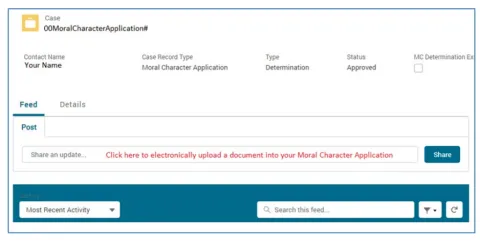
You are required under rule 4.42 of the Rules of the State Bar of California to update your responses within 30 days when information provided in the application has changed or there is new information relevant to the application until you have taken the attorney’s oath. To update your application, please log in to the Applicant Portal and access your moral character case. Use the feed on your moral character case to post an update or upload a document.
Figure 1: Posting an update or document to a Moral Character Case
Is there a preferred file type and file size limit when uploading or posting a document?
Yes, PDF documents are preferred. Word documents are discouraged, as incompatible versions may create technical issues. There is a 25 MB upload limit per post.
I submitted my moral character application at the same time my classmate submitted their application. Why was their application approved quickly while my application remains pending?
Applications are considered individually. Processing times for applications are affected by variables such as the relative complexity of an applicant’s history. It may take 180 days or more from the date the application is deemed complete to finish the processing of a moral character application. You may submit a moral character application after you meet the eligibility requirements by commencing the study of law and registering with the State Bar as a law student or an attorney applicant. Applicants are encouraged to file a moral character application before the start of their last year of law study.
Can I receive a moral character determination before enrolling in law school?
No. You are not eligible to file a moral character application until you commence the study of law and register as a law student with the State Bar. The State Bar has published Moral Character Guidelines to assist applicants for law school and the State Bar in understanding whether their past conduct might impact getting a positive moral character determination, which is a prerequisite for admission to the practice of law.
Civil actions and administrative proceedings
Do I have to disclose my divorce or dissolution? Do I have to disclose a class action suit to which I was a party?
Yes. The moral character application requires disclosure of all civil actions, including but not limited to divorce, dissolution, and class action cases in which you were a named plaintiff or defendant.
Do I have to disclose an administrative matter, such as a Department of Motor Vehicles hearing involving a driver’s license suspension or a hearing before the Employment Development Department?
Yes. You are required to disclose all administrative matters to which you have been a party.
If I reported an incident of sexual assault or sexual harassment to an educational institution (undergraduate, graduate, or law school), do I have to disclose the matter on my moral character application as a civil action or administrative proceeding to which I was a party?
No. An applicant who reported an incident of sexual assault or sexual harassment to an educational institution is not required to disclose the incident on the moral character application as a civil action or administrative proceeding to which the applicant was a party.
However, if a complaint was filed against you and you were formally or informally dropped, suspended, warned, placed on disciplinary probation, expelled, or requested to resign or allowed to resign in lieu of discipline from the educational institution, you must disclose this information on the moral character application in response to the question about scholastic discipline.
Law enforcement matters
Can I take the California Bar Examination if I have a criminal record?
Yes. Eligibility to sit for the California Bar Examination is based upon your legal education. An applicant’s criminal history is addressed in the moral character application, which is separate and distinct from the bar exam application.
Do I have to disclose my criminal history on my law school application?
The State Bar is unable to provide advice concerning the completion requirements of law school applications, including whether disclosure of certain criminal matters is required. An applicant should consult the law school concerning the completion requirements for its application.
On my law school application, I disclosed an arrest that did not result in charges. If the moral character application does not require that I disclose this arrest, how will the discrepancy affect the review of my application?
If an undisclosed arrest is discovered during the processing of a moral character application, the applicant may be asked to provide a narrative of the events and supporting documentation; however, if the arrest was not required to be disclosed on the moral character application, the nondisclosure will not impact the determination.
Do I have to disclose a pending criminal matter in my moral character application? Do I have to disclose a criminal conviction that was dismissed pursuant to section 1203.4 of the California Penal Code?
Yes. Pending criminal matters must be disclosed, and convictions dismissed pursuant to section 1203.4 must be disclosed.
Do I have to disclose a criminal matter that was dismissed pursuant to a pretrial diversion agreement?
Maybe. You are required to disclose criminal matters in which you entered a plea of guilty or nolo contendere (no contest), even if the matter ultimately was dismissed without a judgment of conviction being entered or sentence imposed after you completed the terms of a diversion agreement. You are not required to disclose an arrest or charges that did not result in a misdemeanor or felony conviction unless you entered a plea of guilty or nolo contendere (no contest) or the matter is pending when you submit your application or during the processing of your application.
How do I obtain law enforcement and criminal court records that I am required to submit with my application?
Contact the citing or arresting agency to obtain a copy of a law enforcement report and contact the court where the related proceedings were held to obtain a copy of the charging document, court docket, and judgment (please see Form 2 for the complete list of required documents). You must contact each agency to determine whether records may be requested or obtained online, in person, or through the mail. The identity of the citing or arresting agency may sometimes be found in related court documents. The prosecutor’s office, such as the District Attorney or City Attorney, may be able to assist in identifying the court in which certain proceedings were held.
What do I do if I am required to disclose a criminal offense but am unable to obtain the required law enforcement or court records?
Please submit documentation of your unsuccessful attempts to obtain law enforcement or court records, such as a letter from the relevant entity confirming why the record is unavailable.
Are there criminal offenses that are an absolute bar to a positive moral character determination? Will a misdemeanor or felony conviction alone prevent me from obtaining a positive moral character determination?
No. There is no act of misconduct that automatically disqualifies an applicant from obtaining a positive moral character determination. The State Bar makes moral character determinations on a case-by-case basis, considering each applicant’s history. When an applicant has a criminal history, the State Bar determines whether sufficient rehabilitation and other relevant factors have occurred to warrant a positive moral character determination. Please review the Moral Character Guidelines for additional related information.
What are the criteria for disclosing traffic violations? Do I have to disclose speeding tickets and other moving violations? Do I have to disclose all driving violations, no matter when they occurred?
Traffic violations that resulted in a misdemeanor or felony conviction must be disclosed on the moral character application, as well as the specific examples provided in the moral character application. Violations must be disclosed without regard to when they occurred.
Debt
Am I required to disclose a disputed debt or student loan defaults on my moral character application?
Yes. The moral character application requires disclosure of all debt that is delinquent at the time the application is submitted. Applicants must also disclose all incidents of student loan default, even if the loan is current at the time the moral character application is submitted.
Do I need to provide a credit report with my moral character application?
Maybe. If you disclose a current student loan in default or delinquent debt on the moral character application, you must provide a current credit report dated within the last 30 days. A credit score summary is not acceptable in lieu of a complete credit report if one is required.
Will I be denied admission solely because I owe money on my credit card, or I have declared bankruptcy?
No. Neither indebtedness nor bankruptcy is necessarily relevant to a moral character determination. Moral character issues may arise if indebtedness was handled irresponsibly, or bankruptcy was used to defraud creditors.
Disciplinary history: military, professional, and academic
Do I have to disclose undergraduate and law school discipline on the moral character application?
Yes. If you have been found to have violated a college, university, or law school honor code; or have been dropped, suspended, warned, placed on disciplinary probation, expelled, or requested to resign or allowed to resign in lieu of discipline by any college, university, or law school; or otherwise have been subjected to discipline by any such institution or been requested or advised by any such institution to discontinue your studies, you must disclose the incident on the moral character application.
How will a military discharge “under” or “other than” honorable conditions or a “dishonorable” discharge affect a moral character determination?
A nonjudicial punishment, court-martial, resignation in lieu of court-martial, administrative discharge, or a discharge that is not “honorable” may be relevant to a moral character determination, but it does not automatically exclude an applicant for admission to practice law in California.
Driving record
Do I need to submit a copy of a non-California driving record?
Maybe.
For the Determination Application, you must report all driver’s licenses ever issued to you in the application. For each jurisdiction, other than California, in which you have held a driver’s license within the last 10 years or since the age of 18, whichever is shorter, you must provide a copy of your driving record that meets the following requirements: an original and certified copy, issued within 6 months of the date on which the current application is submitted, and contains at least 5 years of your driving history or the longest timeframe provided by the jurisdiction, whichever is shorter.
For the Extension Application, you must report all driver’s licenses held since your prior application. For each jurisdiction, other than California, in which you have held a driver’s license since your prior application, you must provide a copy of your driving record that meets the following requirements: an original and certified copy, issued within 6 months of the date on which the current application is submitted, and contains at least 5 years of your driving history or the longest timeframe provided by the jurisdiction, whichever is shorter.
If a driving record is in a language other than English, you must provide a certified English translation with the driving record. You may not translate your own documents.
If the jurisdiction that issued the driver’s license will not provide a copy of a driving record, a letter from the agency stating that no record will be provided should be submitted in lieu of the driving record.
My out-of-state driving record may take two to four weeks to obtain. Should I wait to submit my moral character application until I can submit the driving record?
Yes. A certified copy of each out-of-state driving record must be uploaded to the moral character application prior to submission. An application received without the out-of-state driving record(s) will be considered incomplete and will delay the processing of the moral character application.
Education
How do I report my educational history if I attended some colleges multiple times and some schools many years ago?
You are required to account for all periods of your education after high school. Please disclose each school you attended regardless of the duration of your attendance. If you attended a school during different periods of time, please disclose the school once and indicate each period of attendance at the school. You must upload a separate document to list each period of attendance.
Professional applications and credentials
Do I have to disclose my applications for admission to practice law in other jurisdictions?
Yes. The moral character application requires the disclosure of applications submitted to any jurisdiction for admission to practice law including, but not limited to, applications to be admitted by examination, on motion, or on diploma privilege; applications for reinstatement to a State Bar; and applications for determination of moral character. All submitted applications must be disclosed regardless of whether you were admitted, including applications that are withdrawn or otherwise did not result in a final determination.
What professional licenses and credentials do I have to report in the moral character application?
You must disclose all professional licenses that include a character or fitness determination component (i.e., questions concerning convictions or disciplinary matters). Examples of professional certifications that typically include a character or fitness component include licensure as a Certified Public Accountant, Patent Practitioner, Real Estate Salesperson or Broker, Notary Public, and Teacher, or security clearance certifications.
References: personal and employment
Who can I provide as a personal reference on the moral character application?
You should list people who are knowledgeable about you and do not appear as an employment reference elsewhere in the application. Additionally, your personal references may not be related to you by blood or marriage.
Who may provide an attorney reference?
The moral character application requires that at least one of your personal references be an attorney; the attorney may be retired or inactive. If you do not know an attorney who knows you well enough to comment on your character, you may submit the name and contact information of a nonattorney who knows you well enough to complete a questionnaire concerning your character. Neither the attorney nor other personal references may be related to you by blood or marriage, nor can they be reported as a supervisor under the employment section of the moral character application or as a verifying reference under the self-employment section of the moral character application.
Do I have to disclose my current employer or a potential place of employment in the moral character application?
You must disclose your current employer, even if it is not law-related, and you have not been there for at least six months.
You are not required to disclose to a potential employer. The moral character application requires you to disclose any employment, past or present, lasting more than six months, and any law-related employment, regardless of its duration.
If you obtain new employment while your moral character application is pending or after you have received a positive moral character determination, but before you take the attorney’s oath, you must provide the new employment information to the State Bar within 30 days.
Who do I list as my supervisor in the employment section of the moral character application?
Provide the name of your direct supervisor. If you had more than one supervisor, provide the name of the individual most familiar with your conduct. If your supervisor is no longer at the company and you do not have their contact information, please list “Human Resources.”
If your supervisor is related to you by blood or marriage, please list a non-related colleague who is familiar with your work. If no such person is available, you may list your relative as your supervisor. Please note how the supervisor is related to you on your application.
Do I have to disclose my previous employment at a business that is no longer in operation?
Yes. You must disclose all employment that is law-related or lasted more than six months, even when the employer is no longer operating. You do not need to provide a defunct employer’s address, email address, or phone number; however, if you have contact information for your former supervisor from the business, you must provide this information in your application.
What do I do if I do not know the supervisor’s email address?
You must contact the employer and attempt to obtain the information. If you do not remember your supervisor’s name or your supervisor is no longer with the business, please enter "Human Resources" into the Full Name of Supervisor field and enter the appropriate information into the Email Address of Supervisor and Phone Number of Supervisor fields.
If the company is no longer in business (defunct), contact information will not be required once you indicate that the company is no longer in business.
Do NOT use your own email address or phone number.
Does the State Bar contact the employers identified on the moral character application?
Yes. Current and past employers are contacted during the moral character investigation.
How do I properly report my enlistment and job in the military?
Report military enlistment in the “Current/Previous Employment section” and the “Military Services” section of the moral character application. List your last duty station, supervisor, date of enlistment, and date of discharge (or the date you left active duty if you are currently on inactive status). An applicant who is discharged from active duty must also provide a DD-214 military discharge document that clearly indicates the type of discharge.
Some of my references told me they did not receive a questionnaire after I submitted my application, should I be worried?
No. Some references may not be contacted. You may wish to remind your references to check their email spam folders periodically and to use the Google Chrome internet browser, if possible, when submitting the questionnaires to avoid potential technical issues.
Residence
Do I have to disclose all past residences, no matter how long ago I resided at a location?
No. You are only required to disclose the addresses of the places you have lived within the past eight years, including college and law school residences. If a residence gap is identified due to your extended periods of travel abroad, please report this information in the “Accounting for Gaps in Residence History” section of the moral character application.
How long must I have resided at a particular location for the residence to be reportable on the moral character application?
You must disclose all residences for the past eight years, regardless of how long you resided at the location.
I travel a lot, including overseas, and I cannot recall every address where I lived. How do I appropriately respond to the “Residence” section of the moral character application?
Some applicants have traveled extensively in the past eight years and have numerous addresses to report on the moral character application. You are encouraged to provide as much information pertaining to each residence as can be reasonably recalled. You are responsible for the complete and accurate reporting of information on the application to the best of your ability, and the failure to provide complete responses could result in a delay in the processing of the application.
Admissions applicant portal
I cannot log in to my account on the Admissions Applicant Portal. What do I do?
First, try to reset the password. Second, call the Office of Admissions at 800-843-9053 and request a password reset email. Please do not register with another email address, as doing so will create a duplicate account.
Which email address should I indicate as my preferred email?
Please use a personal email address other than your law school email address. If you use a law school or work email address to which you lose access, you may not receive communications from the Office of Admissions.
Can I correct or update information in my moral character application before I submit it?
Yes. Prior to submitting your moral character application, certain fields are editable by you. The editable fields are visible on each type of record.
If you cannot edit the information on the application, you should upload a document (Word, PDF, etc.) with the correct information to any file upload section.
How do I delete documents that I accidentally uploaded to the application?
You cannot delete a document once it is uploaded. If you upload a document in error, please upload a statement that clearly identifies the relevant document and indicates if the document should be deleted.
Can I view my application in the Applicant Port after I have submitted it?
No. However, you will receive a courtesy copy of your application via email for your records.
After an application has been submitted, you will not be able to access the application or make any edits to it in the Applicant Portal. You should submit updates or amendments by posting the information to your moral character case feed.
Can I request a copy of my application?
Yes. A copy of your moral character application can be requested by submitting a Service Request Form with the applicable fee as a General Request in the Applicant Portal. Please allow approximately 30−45 days to process the request.
How do I upload my Live Scan Form after I submit my application?
Post the completed Live Scan Form to your moral character case feed. Do not submit the Live Scan Form as a General Request or as a Fingerprint Request, or there may be a delay in processing.
Will I receive immediate confirmation that the document or comment I posted to my moral character application was received?
No. However, you can view the documents you have successfully uploaded to your case in the Applicant Portal. You will receive confirmation once staff reviews the information.
I am confused as to when it is appropriate to submit a General Request. When should I submit a General Request?
You may submit a General Request to ask questions that are not related to your moral character application, request FD-258 fingerprint cards, or request assistance with the application prior to submission. General Requests are answered in the order received, and there may be a delay before the General Request is addressed as the volume of requests varies.
My application is in drafted status, and I am experiencing technical issues. What is the best way to resolve the issue?
Please call 415-538-2450 and ask to speak with the moral character Person of the Day. Please be prepared to email a screenshot if the issue cannot be resolved over the phone. Some issues may take more time to resolve if technical assistance is necessary.
Adverse determination
What happens if I am given an adverse moral character determination?
The notice of the adverse determination will provide you with the date on which you may submit a new Application for Determination of Moral Character. You are encouraged to engage in affirmative rehabilitative activities during the period you must wait to reapply.
Alternatively, you may choose to request administrative review by the Committee of Bar Examiners. If you request review by the Committee, the date on which you will be eligible to reapply may change, as it will be determined by the Committee in the event it issues an adverse determination.
What are the possible outcomes once I submit a request for administrative review?
The Committee of Bar Examiners will review your request and your application. The Committee may take any action it deems appropriate, including but not limited to granting you a positive determination, requesting more information, extending an offer of abeyance, or rendering an adverse determination.
If the Committee declines to grant you a positive determination, it will decide how long you must wait before you may submit a new Application for Determination of Moral Character, which could be the same or different from the time that was set by State Bar staff when it made the initial determination, and will be calculated from the date of the Committee’s determination.
Can I have an extension to submit a request for administrative review?
No. The State Bar is unable to extend the period to request administrative review. The Committee will decide whether to accept an untimely request for administrative review.