The LOS Program allows you to complete your legal education by studying law in a law office or judge’s chamber.
You will complete four years of recognized law study in a law office under the supervision of a qualifying attorney or in a judge's chamber under the supervision of a judge of a court of record in California.
Why am I required to report my pro bono hours to the State Bar?
The State Bar collects information on attorneys’ pro bono and reduced fee hours to better understand how these services are being provided across the profession. The data will be analyzed to identify trends, support efforts to expand access to legal services, and help address the justice gap. All reported data will be aggregated and not linked to individual attorneys.
How do I calculate and submit Speakers Credit and Teaching Credit?
Speaking
Please submit course marketing materials that clearly show that the course was approved for MCLE, who the speakers were and how long the course was. You should also submit your certificate of attendance for that course if you were provided with one.
You may only claim speakers credit for approved MCLE activities. If you were part of a panel or you only presented a portion of the program you may only claim incremental speakers credit for the activity.
Teaching
You receive 12 times the credit hours awarded by the law school for the course. There is an exception for subfield requirements in Ethics, Elimination of Bias, Implicit Bias, Mental Competence (mental issues in the legal world or society), Wellness (mental competence specifically in the legal world ), Civility and Technology hours. For these "subfields," you only receive the actual speaking time.
To fill out the online form use the law school as the provider, the course title as the course and the date the class started as the date. Mark the course as participatory and note any qualifying subfield hours. Submit a syllabus and a letter from the law school stating that you were an instructor, the dates of the course, and the number of academic credits the school awarded for it.
What items am I allowed to bring into the exam room?
Items listed in the Admittance Ticket Bulletin are allowed without prior approval. The Admittance Ticket Bulletin can be found on the First-Year Law Students’ Examination webpage. Items not listed in the bulletin will require approval through the testing accommodations process. If the bulletin is not yet available for the exam you intend to take, refer to the bulletin for the prior administration of the exam; however, please note that the bulletin is subject to change.
Who is eligible to participate in the Installment Payment Plan?
Attorneys who are eligible for fee scaling and agree to comply with all required obligations by the April 1, 2025, including:
Attorney profile verification
Client Trust Account Protection Program
MCLE compliance (if applicable) I
f an attorney is assessed a noncompliance penalty for any required annual reporting obligation, they will no longer be eligible for the installment plan and must pay all outstanding fees and costs in full by June 30, 2025.
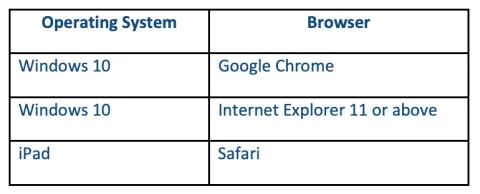
I have completed all of the screen elements and the course is still stuck or frozen on a particular screen; OR I have completed a course but it still shows as being in progress or takes me back to the beginning; OR I went back to complete a course and it is not resuming where I left off.
These issues are likely the result of the learner’s device referring to an earlier memory cache (version) of the course and the device not refreshing correctly. The following steps usually resolve this issue:
Clear your browser’s memory cache/history.
Try using a different Internet browser. See below for optimal settings.
Try launching the course on a different device.
Optimal Settings:
Image
Do I qualify to study law through the LOS Program?
You must fulfill the pre-legal education requirements that apply to students who attend law school. This includes at least two years of college work or equivalent intellectual achievement by attaining a score of 50 or higher on specified College-Level Examination Program (CLEP) examinations, as detailed on the College Equivalency Education webpage.
Your pre-legal and any completed legal education will be evaluated upon submission of your LOS application. You must register with the Office of Admissions, and the Registration Application must be approved before you can submit an LOS application. When submitting your Application for the Law Office Study Program, you must submit your official, sealed undergraduate transcripts, CLEP scores, or a course-by-course evaluation of your foreign study from an approved credential evaluation agency if you have foreign undergraduate study. All official, sealed legal education transcripts must also be submitted before your participation in the LOS Program can be approved.
All sealed official transcripts must be mailed to the Los Angeles Office of Admissions. Electronic transcripts are not acceptable.
What is required?
The State Bar encourages, but does not require, active California licensees to provide pro bono legal services each year. While providing pro bono or reduced legal fee services is not mandatory, licensees are required by Business and Professions Code section 6073.2 to annually report the amount of these services performed each year. Licensees will report either their hours in ranges (e.g., less than 1 hour, 1–5 hours, 6–10 hours, 11–19 hours, etc.), that they did not track their pro bono or reduced fee legal services hours, that they did not complete any pro bono or reduced fee legal services hours, or that they decline to answer.
What authorization does the State Bar have to require that I fill out the online form or submit to the audit?
The State Bar was charged with administering the MCLE program by an act of the California Legislature which amended B&P code to require MCLE for attorneys. The Supreme Court also authorized the program by rule of court, giving the State Bar authority to administer the program and to place non-compliant members on administrative Inactive status. State Bar MCLE Rule 2.73 authorizes the state bar to require certificates of attendance.
How does the installment plan provide flexibility?
The plan allows attorneys to spread their total fee into smaller, manageable payments while ensuring compliance with their financial obligations.