Will you send me a reminder before my deadline? Will there be a reminder in My State Bar Profile?
No. The State Bar will not send a reminder before your NAT completion deadline. You are personally responsible for tracking and meeting your deadline.
If you do not complete NAT by your deadline, the State Bar will send you a notice of noncompliance. The notice will explain that you must complete NAT and pay any assessed noncompliance penalty to avoid being enrolled as inactive and becoming ineligible to practice law.
Because NAT is a onetime requirement, it may not appear in the same area of My State Bar Profile as your annual MCLE compliance obligations. Remember to:
Keep your email address and mailing address current with the State Bar,
Review your notifications in My State Bar Profile regularly, and
Complete NAT well before your deadline.
If I miss the deadline, how do I pay the noncompliance penalty?
If you do not complete NAT by your deadline, you will be assessed a noncompliance penalty, which may take up to 90 days to appear in My State Bar Profile. To pay the noncompliance penalty:
Select “Compliance Dashboard” in the top navigation menu.
In the “Annual License Fee Status” section, select “Pay your annual fees.”
Select “Calculate and pay my fees.”
Follow the instructions to pay any outstanding balance.
Even after a noncompliance penalty has been assessed, you are still required to complete NAT. If you do not complete NAT and resolve any assessed fees by the applicable deadlines, you may be enrolled as involuntarily inactive and become ineligible to practice law.
What is the New Attorney Training Program?
The State Bar of California’s New Attorney Training (NAT) Program is a mandatory online training program for all newly admitted California attorneys. It consists of nine State Bar–produced courses covering professional responsibilities and practical skills for practicing law. The courses may be completed in any order and at your own pace.
Topic
MCLE Credit
Attorney as an Officer of the Court—Civility and Pro Bono Legal Services
1.0 hour of Civility
Attorney Communication Duties
1.25 hours of Legal Ethics
Attorney Well-Being: The Bedrock of Competence
1.0 hour of Competence: Prevention and Detection
Attorney-Client Relationships
1.25 hours of Legal Ethics
Conflict Resolution, Interpersonal and Communication Skills, and Technology
0.75 hours of General
Elimination of Bias
1.0 hour of Elimination of Bias
Introduction to Law Practice Management Skills
1.0 hour of General
The Attorney as a Fiduciary of Funds and Property of Clients and Others
1.5 hours of Legal Ethics
The Duty of Confidentiality and Conflicts of Interest
1.25 hours of Legal Ethics
Can I claim MCLE credit for NAT courses?
The State Bar’s New Attorney Training is a separate requirement and is not MCLE. However, you may apply NAT course hours toward your MCLE requirements if you complete the hours during your first MCLE compliance period. (Rule 2.142.) Review your MCLE requirements, including any proportional requirement, to determine whether and how the NAT hours apply to your situation.
When is my deadline to complete NAT?
You must complete NAT by the last day of the month of your one-year anniversary as a State Bar licensee. (Rule 2.141.)
For example, if you were admitted on October 15, your deadline is October 31 of the following year. If you have a question about your deadline, complete the Licensee Records and Compliance Inquiry form.
How do I access the New Attorney Training?
The New Attorney Training Program courses can be accessed through My State Bar Profile. The fee to access all nine courses is $55. Fee waivers are not available.
Locate the e-learning section toward the bottom of the home page, and select “E-Learning Portal.”
On the E-Learning Dashboard’s top navigation bar, select “View Catalog.”
In the search box, type “New Attorney Training.”
Select “Add to Cart” and complete the checkout process.
After you purchase the courses, when you return to the E-Learning Dashboard, select “Not Started” to locate the course you want to start. Then, select the red + button to the right of the course title, and select “Launch.”
Can I get a fee waiver for the course?
No. Fee waivers are not available. The fee to access all nine NAT courses is $55.
Can I request an exemption or time extension?
There are no exemptions from the NAT requirement. (Rule 2.143.)
Time extensions are granted only in rare cases involving documented personal hardship. (Rule 2.144.) If you believe you have a qualifying hardship, submit the applicable State Bar request as soon as possible and ideally before your NAT deadline, if feasible.
Submitting a request does not excuse compliance unless the State Bar grants it. Do not delay beginning or completing NAT while awaiting a decision.
I’m a former Provisional Licensure Program (PLP) participant and was recently admitted. Do I need to take NAT again?
If you completed any portion of NAT while enrolled in the State Bar’s PLP, you are considered to have satisfied that portion of the NAT requirement and do not need to retake it. Make sure you complete all nine NAT courses by the deadline.
Check your E-Learning Portal to confirm that your completed courses are reflected. If a completed course does not appear in your record, contact elearning@calbar.ca.gov for assistance.
As a federal or state employee, am I exempt from completing NAT?
No. Although certain federal or state employees may be exempt from the general MCLE requirement, there are no exemptions from the NAT requirement for new licensees. (Rule 2.143.) You must complete NAT by your one-year admission anniversary deadline.
How do I file a complaint against my lawyer or a lawyer referral service?
If you believe your lawyer has done something wrong, you can file a complaint with the State Bar. Complaints may be submitted online or by mail. If you have questions or need assistance in completing the form, call the State Bar’s Attorney Complaint Hotline at 800-843-9053. For more information on reporting a lawyer to the State Bar and handling other problems, read the legal guide If You Have a Problem with an Attorney.
If you have a complaint about a certified or uncertified LRS, you can file a complaint against the service with the State Bar. In order to promote public protection, the State Bar will review your complaint to determine if the LRS has violated Business and Professions Code Section 6155 and State Bar Rules.
For more information on certified lawyer referral services, contact LRS@calbar.ca.gov.
When are the annual fees due?
The due date is by March 30, or the next business day if that date falls on a weekend or holiday, each year during the annual license renewal process. The 2025 annual deadline is April 1, 2025. If you miss the deadline, you will be charged a penalty ($103 for active attorneys, $31 for inactive attorneys).
What activities qualify for general MCLE credit?
Activities that qualify for general MCLE credit must: (1) relate to legal subjects that are directly relevant to California attorneys, and (2) offer current, significant educational, professional, or practical content with the specific objective of increasing each participant’s professional competency as an attorney. Programs created primarily for nonattorney audiences (for example, general public, clients, or business staff) do not qualify and will not be approved for general MCLE credit. More on Standards for MCLE activity Approval.
What is IOLTA?
IOLTA stands for Interest on Lawyers’ Trust Accounts. Attorneys deposit client funds that they plan to hold briefly, or that are too small to earn interest for the client, into larger shared accounts. Over 73,000 attorneys make deposits in approximately 49,000 IOLTA accounts in California. As of September 2019, IOLTA accounts hold nearly $5 billion. Any interest earned on these accounts is paid by financial institutions to the State Bar, which in turn distributes those funds as grants to qualified nonprofit civil legal organizations throughout the state.
Refer to the State Bar’s IOLTA FAQ page for more information.
How do participants in the Pathway PLP report their hours to the State Bar? And how frequently?
Hours must be tracked and submitted to the Office of Admissions on a weekly basis. Specifically, PLLs will be required to note the total number of hours worked, the total number of hours spent performing legal services (whether paid or unpaid), and a description of the supervised legal practice duties assigned that specific week. When the hours are submitted, the State Bar will contact the supervising lawyer to sign that week’s completed log. To access the time-tracking log:
Once that timesheet record has been saved, the applicant will receive an email with a link to capture their electronic signature. After receipt of that electronic signature, an email will be sent to the supervising attorney to confirm the hours reported.
Once a PLL has logged a total of 300 hours of supervised legal practice, an email will be sent to the supervising lawyer requesting an evaluation of the PLL’s overall work performance. Once that evaluation has been completed, it will be reviewed by the eligibility team to determine whether the PLL has satisfactorily met the requirements of California Rule of Court 9.49.1 (i).
May a provisionally licensed lawyer have multiple supervising lawyers to get a broader range of experience?
Yes, the rules allow for multiple supervisors. The supervisors may work within the same law firm or at a different law firm if you will be employed or volunteer at more than one organization. You must submit a declaration from each supervising lawyer with your application in the Applicant Portal. You may not work at any organization unless you have submitted a declaration from a supervising lawyer with that organization, and the State Bar has approved the supervisor as eligible.
The instructions state that applicants for admission to practice law in California have a continuing duty to update their responses. What is the best way to update my application?
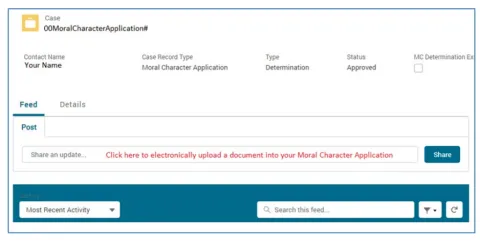
You are required under rule 4.42 of the Rules of the State Bar of California to update your responses within 30 days, whenever information provided in the application has changed or there is new information relevant to the application, until you have taken the attorney’s oath. To update your application, please log in to the Applicant Portal and access your moral character case. Use the feed on your moral character case to post an update or upload a document.
Figure 1: Posting an update or document to a Moral Character Case
Image
Do I have to disclose my criminal history on my law school application? Should I update my law school application if I am arrested or convicted during law school?
Criminal history questions on law school applications vary widely. The State Bar is unable to provide advice concerning any particular application, including whether the application requires disclosure of arrests, convictions, or other criminal history information. An applicant should contact their law school for information about its application disclosure requirements, and under what circumstances updates to the law school application are required.
Am I required to disclose a disputed debt on my moral character application? Am I required to disclose student loan defaults?
Yes. The moral character application requires disclosure of all debts that exceed $10,000 and are delinquent at the time the application is submitted.
Do I have to disclose my applications for admission to practice law in other jurisdictions?
Yes. The moral character application requires the disclosure of applications submitted to any jurisdiction for admission to practice law including, but not limited to, applications to be admitted by examination, on motion, or via diploma privilege; applications for reinstatement; and applications for determination of moral character. All submitted applications must be disclosed regardless of whether you were admitted, including applications that were withdrawn or otherwise did not result in a final determination.
Does the State Bar contact the employers identified on the moral character application?
Yes. Current and past employers are contacted during the moral character investigation.
Can I correct or update information in my moral character application before I submit it?
Yes. Prior to submitting your moral character application, certain fields are editable by you. The editable fields are visible on each type of record.
If you cannot edit the information on the application, you should upload a document (Word, PDF, etc.) with the correct information to any file upload section.
What happens if I am given an adverse moral character determination?
The notice of the adverse determination will provide you with the date on which you may submit a new Application for Determination of Moral Character. You are encouraged to engage in affirmative rehabilitative activities during the period you must wait to reapply.
Alternatively, you may choose to request administrative review by the Committee of Bar Examiners (CBE). If you request review by the CBE, the date on which you will be eligible to reapply may change, as it will be determined by the CBE in the event it issues an adverse determination.
2.3 Who is NOT required to complete the CTAPP reporting requirements?
The only licensees who are exempt from the annual reporting requirement are licensees who were on voluntary inactive status for the entirety of the reportable time period. All other licensees, including those who were active, suspended, or not entitled to practice law at any point in the reportable time period, are required to complete the CTAPP reporting requirements for that reportable time period.
2.11 I am a licensed attorney and also a nonlegal professional (e.g., probate trustee, investment advisor, real estate agent, business manager, etc.). Do the Rules of Professional Conduct (e.g., rule 1.15) apply, and do I need to report and register any trust account as part of CTAPP?
When a licensee performs both legal and non-legal professional services for a client, the licensee is subject to the Rules of Professional Conduct with respect to all of those services. (See Cal. State Bar Formal Opn. Nos. 1982-69, 1995-141, and 1999-154.)
Therefore, a key question is whether the licensee is performing legal services and, as a result, is subject to rule 1.15 and the other Rules of Professional Conduct. If not, and the licensee is merely a real estate broker who happens to be a lawyer, rule 1.15 may not apply. Similarly, if the licensee is a trustee but did not perform any legal services related to the creation of the trust and does not perform any legal services related to the trust, rule 1.15 may not apply. On the other hand, if the licensee is acting as both the real estate lawyer and broker, and the lawyer receives entrusted funds from, or for, the transaction, rule 1.15 would apply, and any accounts need to be reported and registered as part of the licensee’s CTAPP compliance. The same is true of lawyers providing other non-legal professional services, regardless of whether they, as a trustee, for example, report to the probate court.
If you have further questions on dual capacity, including whether you are responsible for complying with any of the requirements or prohibitions in rule 1.15, please contact the State Bar’s Ethics Hotline research service at 800-238-4427 (toll-free in California). The Ethics Hotline cannot provide legal advice, nor tell you how to comply with any of the CTAPP requirements, including whether to answer “yes” or “no” in any portion of the CTAPP reporting requirements.
Why am I required to report my pro bono hours to the State Bar?
The State Bar collects information on attorneys’ pro bono and reduced fee hours to better understand how these services are being provided across the profession. The data will be analyzed to identify trends, support efforts to expand access to legal services, and help address the justice gap. All reported data will be aggregated and not linked to individual attorneys.
Does the State Bar have a program for attorneys who only want to do pro bono work?
The State Bar’s Pro Bono Practice Program (PBPP) allows attorneys who would otherwise be inactive to maintain an active license, free of fees, to exclusively provide pro bono legal services in partnership with a pro bono legal services provider. To qualify for the PBPP, an attorney must maintain an active license, submit an application annually for the program, be certified as a pro bono practice attorney, and exclusively provide pro bono legal services through an approved or qualified pro bono services provider. For more information, see the Pro Bono Practice Program webpage.
How do I change the attorney or judge under whom I study?
You may request to study under a different attorney or judge by submitting a new LOS application, the required documentation, and the fee in the Applicant Portal at least 15 days prior to beginning study with the new supervisor. The new application must include a completed declaration signed by the new supervising attorney or judge and a new law study outline.
If you change the attorney or judge under whom you are studying during a six-month study period, you must submit a report from your previous attorney or judge that indicates all study completed with that person, along with the semi-annual report fee in the Applicant Portal, within 30 days of beginning study with the new attorney or judge. Within 30 days of completion of the six-month study period, you will also have to submit a semi-annual report reflecting the study conducted under the new attorney or judge that covers the remainder of the six-month study period.
How do I log out of the e-learning portal?
Click the ← MY STATE BAR PROFILE button at the top right of the e-learning portal to log out and return to the My State Bar Profile page.
What is the Installment Payment Plan?
The recently signed licensing fee bill requires the State Bar to offer an installment payment plan to active licensees eligible for fee scaling. This plan allows attorneys to divide their total annual fees into six equal payments instead of paying in full by the original deadline of April 1, 2025.
Can I opt out of the program after opting in?
No, once you opt in for the installment payment plan, you cannot opt out unless you are ineligible for fee scaling.
Who approves my application for PHV?
The court must approve your application in order for you to appear as PHV in a case. While the State Bar's Applicant Portal may show that your PHV case is "approved," this refers to the internal processing of your application and should not be taken as the court's approval of your appearance as PHV.
What happens if a Provisionally Licensed Lawyer is found culpable of misconduct?
If the State Bar Court determines that a PLL is culpable of conduct that would result in discipline if they were fully licensed by the State Bar, or if the PLL is sanctioned for misconduct by any court or professional licensing authority, the provisional license terminates, and the matter is referred to moral character.
How do I report a concern, challenge, or feedback about my experience in the PLP to the State Bar?
If you are a PLL or a Supervising Lawyer, please send an email to provisionallicensure@calbar.ca.gov to share any concerns, challenges, or feedback about your experience in the PLP. While this is not a formal complaint process, we value your input and feedback.
Staff who review the submissions may:
Reach out to your supervisor, with your permission, to discuss with them the concerns you are having;
Connect you with the Lawyer Assistance Program (LAP) to get career counseling;
Connect you with professional associations or your law school to assist in locating a new Supervising Lawyer;
Pursuant to rule 8.4.1, if you believe your Supervising Lawyer has engaged in discrimination, harassment, or retaliation, we will direct you to the complaint process and provide assistance, as needed; or
Collect data to understand systemic issues, etc.
Contact us
Need additional help? Visit our Contact Us page for additional resources.